
Grinder or Masher: What's the Difference?
Weed Wissen
Anyone familiar with cannabis knows the grinder, the standard tool for turning flower into even, finely ground pieces. But another word is popping up more and more often: masher. Both tools are made to break down weed, yet they do it in completely different ways. And that difference shapes the whole experience.
What is a grinder?
A grinder is a handy shredding tool with sharp grinding teeth on the inside. Twisting the two halves against each other grinds the herb evenly. The result is a fluffy consistency that's perfect for joints, pipes or a vaporizer.
Depending on the model, a grinder comes in two, three or four parts. Premium versions also have a pollen screen that collects the fine resin crystals, known as kief, in a separate chamber. You can process these later or use them as an especially potent addition.
Typical materials: aluminium, stainless steel, wood or acrylic.
Advantages of a grinder:
- ✅ Even, finely ground material
- ✅ Ideal for rolling or vaporizing
- ✅ Collects kief thanks to the built-in screen

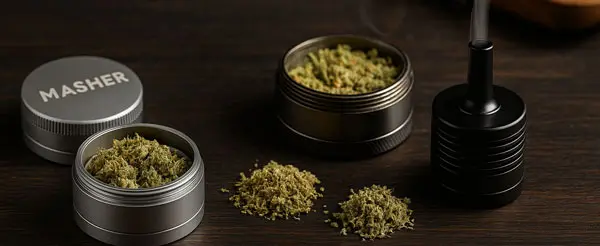
Visible at a glance: the difference between the grinding mechanisms of a grinder (left) and a masher (right).
What is a masher?
A masher is, in a sense, the "raw build" among shredding tools. Instead of grinding, it simply crushes or presses the material, much like a pestle in a mortar. The result is noticeably coarser, more uneven and stickier than with a grinder.
Mashers are usually one-piece and often made of metal or glass. They have no moving parts and no screen. They come into their own above all when you want to break down particularly sticky or resinous buds that would quickly gum up a conventional grinder.
Advantages of a masher:
- ✅ Fast and fuss-free to use
- ✅ No cleaning or screwing together needed
- ✅ Especially suited to resinous material
The modern masher-grinder: gentle instead of sharp
There's now a new type of masher that looks like a classic grinder but does without grinding teeth. Instead of tearing the herb, it breaks it down evenly through pressure, as seen for example in the masher by Black Leaf. Two textured surfaces gently press the plant material apart without shredding it.
The benefit of this principle lies in how gently it treats the trichomes, the resin-rich parts of the flower where flavour and active compounds sit. By skipping sharp teeth, aromas, structure and resin are better preserved. The result is a fluffy, loose grind that's excellent for use in a vaporizer.
Also practical: with no teeth, no plant residue can get stuck. That makes cleaning especially easy. Many modern mashers are also multi-part, with a pollen screen, collection chamber and scraper, offering the same functions as a conventional grinder, just with a different mechanism.
Advantages of modern masher-grinders:
- ✅ Gentle shredding without loss of aroma
- ✅ No jamming from resin or sticky buds
- ✅ Ideal for vaporizer users
- ✅ Easy to clean and robustly built
Comparison: grinder vs. masher
Both tools have their place, what matters is the consistency you prefer and how you consume. The overview below shows the key differences at a glance:
| Feature | Grinder | Masher |
|---|---|---|
| How it works | Grinds the herb with sharp teeth via a twisting motion | Crushes the herb through pressure, no grinding teeth |
| Result | Fine, even, ideal for joints or a vaporizer | Loose, fluffy, aromatic, especially good for a vaporizer |
| Build | Multi-part, usually with screen and collection chamber | Multi-part or one-piece, depending on the model |
| Materials | Metal, aluminium, wood, acrylic | Metal or glass, often aluminium |
| Handling | Twist for an even grind | Pressure via rotating or flat plates |
| Advantages | ✅ Even grind ✅ With pollen screen ✅ Proven design | ✅ Gentle & aroma-friendly ✅ No cleaning teeth ✅ Ideal for vaporizers |
| Disadvantages | ❌ More involved to clean ❌ Teeth can gum up | ❌ Less classic grind result ❌ Slightly pricier to buy |
Which one is worth it, and when?
If you value an even consistency and clean handling, a classic grinder is the best choice. Especially for rolling joints or packing pipes, finely ground herb makes for an even burn and full flavour.
The masher, particularly the modern toothless models, is ideal if you use a vaporizer or prefer an especially aromatic result. It works gently, avoids resin loss and is easy to clean day to day.
Grinder or masher for the vaporizer?
When vaporizing cannabis, the consistency of the material plays a decisive role. For vaporizers, especially so-called dry herb vaporizers, a finely to medium-finely ground herb is recommended. Only then can the hot air flow evenly through the material and vaporize all the active compounds efficiently.
A grinder therefore remains a classic: it delivers an even particle size and an ideal surface. But the modern masher-grinder is barely behind, it offers a gentler alternative that's especially interesting for aroma lovers and frequent vaporizer users.
Tip: if you want to know how to keep your grinder properly clean, read our post "Cleaning your grinder", full of practical tips and home remedies.
Grinder oder Masher für den Vaporizer?
Beim Verdampfen von Cannabis spielt die Konsistenz des Materials eine entscheidende Rolle. Für Vaporizer – insbesondere sogenannte Dry-Herb-Vaporizer – wird ein fein bis mittel-fein gemahlenes Kraut empfohlen. Nur so kann die heiße Luft gleichmäßig durch das Material strömen und alle Wirkstoffe effizient verdampfen.
Ein Grinder ist daher weiterhin ein Klassiker: Er sorgt für gleichmäßige Partikelgröße und ideale Oberfläche. Der moderne Masher-Grinder steht dem aber kaum nach – er bietet eine schonendere Alternative, die besonders für Aroma-Liebhaber:innen und häufige Vaporizer-Nutzer:innen interessant ist.
Tipp: Wenn du wissen willst, wie du deinen Grinder richtig sauber hältst, lies unseren Beitrag „Grinder reinigen“ – mit vielen praktischen Tipps und Hausmitteln.
Life Hack: THC-Rückstände im Grinder in Milch auskochen