
Glass Thickness: Understanding the Wall Thickness of Bongs
Weed Wissen
Ah, we've all been there, haven't we? You barely tap your bong against the edge of the sink, leave it standing by the window where gravity suddenly takes an interest, or a furry housemate the size of a small car saunters across your pride and joy ... and there go the shards. Why does this keep happening? Some blame Satan's meddling fingers, others suspect a conspiracy among manufacturers who, after all, have no interest in bongs lasting forever. Killjoys, meanwhile, insist that glass simply breaks easily ... outrageous! But as tends to be the way with strange theories, they turn out to be true surprisingly often: intelligence agencies really do spy, and glass really does break! The only remedy is care, respect for your gear and the thickest glass you can get, the kind that shrugs off the odd knock. And so Lemmy of Motörhead (or whoever else dreamed up this universe) decreed that the following standard thicknesses shall henceforth be the indelible benchmarks in the subculture of bong smoking:
- 3 mm
- 5 mm
- 7 mm
- 9 mm
But what looks like an eternally valid rule can, sadly, easily (dis)appoint. These figures are often only rough guides and shouldn't be taken as exact. It starts with the fact that a stated "3 mm wall thickness" can in reality mean 2.8 mm or even 3.2 mm. The manufacturing process just doesn't allow it to be pinned down more precisely. Bear in mind, too, that the quoted thickness only applies to the straight parts such as the neck, the cylinder and possibly the base. Anything with curves (the ice notches, for example) often comes out noticeably thinner and is therefore more prone to breaking. And even if you reach for a 9 mm compact bong: caution and respectful handling remain the golden rule of the bong game. Why? Because glass just breaks ...
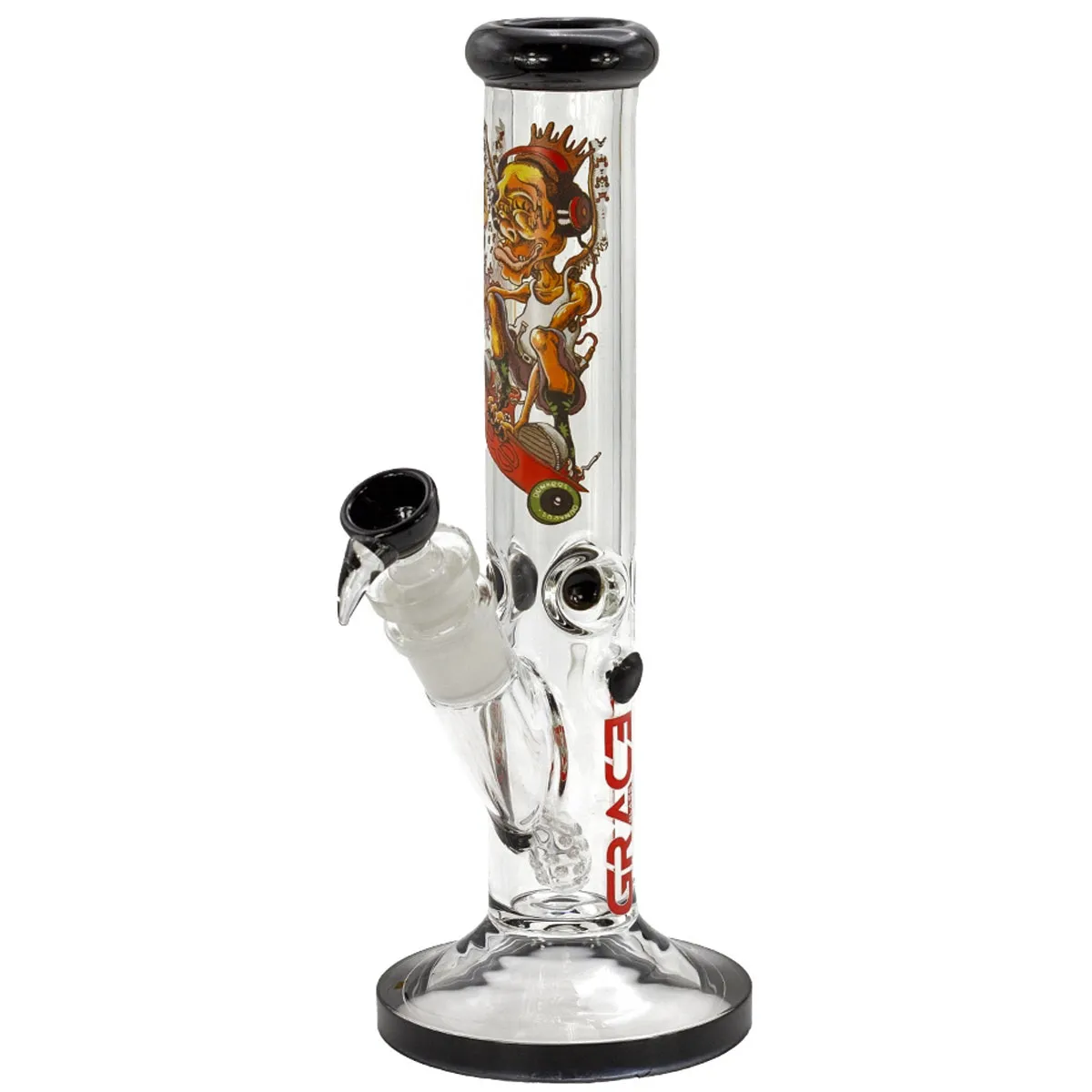
Glass thickness is a decisive feature when choosing a bong, because it influences durability, stability and the smoking experience. Here's an overview of the common glass thicknesses and what they bring to the table:
1. Thin glass (2-3 mm)
- Advantages:
- Lighter and often cheaper.
- Ideal for occasional users or on the go.
- Disadvantages:
- Less sturdy, more prone to breaking.
- Can be damaged easily by harder knocks or sudden changes in temperature.
2. Medium glass thickness (4-5 mm)
- Advantages:
- A good balance between stability and handling.
- Fairly robust for everyday use.
- Still light enough to stay handy.
- Disadvantages:
- Slightly heavier than thinner versions.
- Costs a bit more than thin glass.
3. Thick glass (6-9 mm)
- Advantages:
- Extremely robust and long-lasting.
- Particularly resistant to breaks and knocks.
- Perfect for heavy users or for sessions in a group.
- Disadvantages:
- Heavier, which makes the bong harder to transport.
- More expensive to buy.
Conclusion
The right glass thickness comes down to your own needs. If you're after a light, portable bong, thinner glass will keep you happy. For frequent use or passing it around in company, a sturdier version with thicker glass is the better bet. In the end it's also worth weighing up how carefully you handle your bong and how much you're willing to spend for that extra longevity.


1. Dünnes Glas (2-3 mm)
- Vorteile:
- Leichter und oft günstiger.
- Ideal für Gelegenheitsnutzer oder unterwegs.
- Nachteile:
- Weniger stabil, anfällig für Brüche.
- Kann bei stärkeren Stößen oder plötzlichen Temperaturwechseln leicht beschädigt werden.
2. Mittlere Glasdicke (4-5 mm)
- Vorteile:
- Gute Balance zwischen Stabilität und Handhabung.
- Relativ robust für den täglichen Gebrauch.
- Immer noch leicht genug, um handlich zu sein.
- Nachteile:
- Etwas schwerer als dünnere Varianten.
- Höhere Kosten im Vergleich zu dünnem Glas.
3. Dickes Glas (6-9 mm)
- Vorteile:
- Extrem robust und langlebig.
- Besonders widerstandsfähig gegen Brüche und Stöße.
- Optimal für Vielnutzer oder für den Einsatz in Gruppen.
- Nachteile:
- Höheres Gewicht, wodurch die Bong schwerer zu transportieren ist.
- Teurer in der Anschaffung.
Fazit
Die Wahl der Glasdicke hängt von den individuellen Bedürfnissen ab. Wer eine leichte, transportable Bong sucht, wird mit dünnerem Glas zufrieden sein. Für den häufigen Gebrauch oder den Einsatz in Gesellschaft empfiehlt sich jedoch eine stabilere Variante mit dickerem Glas. Letztlich sollte man auch den eigenen Umgang mit der Bong und die Bereitschaft, mehr Geld für Langlebigkeit auszugeben, berücksichtigen.