
Cigarette Injectors: How to Find the Model That's Right for You
Weed Wissen
Buying a cigarette injector: which one suits you
Anyone who regularly fills their own cigarettes quickly notices that the choice of injector makes a big difference. With the right device you can fill tubes quickly, evenly and without much frustration. In this article you'll get an overview of the main types of cigarette injectors, their strengths and weaknesses, plus tips for beginners and heavy users.
Cigarette injectors at a glance
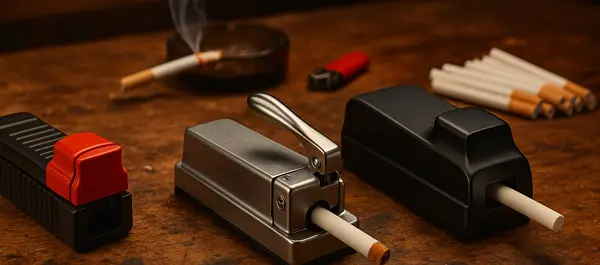
A cigarette injector is a device you use to fill cigarette tubes with tobacco. Unlike classic rolling, you don't do part of the work with your fingers here; instead you leave the filling to a mechanism. The result is cigarettes that look like factory-made ones and often offer a very even draw.
There are basically three groups. There are simple manual injectors, semi-automatic or more comfortable lever devices and electric injectors that take on most of the work for you. Which version suits you depends above all on how often you fill, how much budget you have and how important comfort is to you.
💡 If you've already got a bit of practice, you'll often do just as well with cheaper, conventional rolling machines !Manual cigarette injectors: features and uses
Manual injectors are the simple basic solution for anyone who fills tubes occasionally or in smaller quantities. They're usually made of plastic or metal with a tobacco chamber and a mechanism that pushes the tobacco into the tube when you move a lever or slider.
The biggest advantage lies in the simple mechanics. There's little that can break, and the devices are relatively cheap. Manual injectors are a good fit if you fill a few cigarettes a day or just want to try filling tubes for the first time. With a little practice you get an even fill and can control the amount of tobacco fairly well.
With cheap plastic models in particular, though, the downside shows up quickly. If they're used very often or with too much force, the moving parts wear out or, in the worst case, break. Anyone who fills a lot over the long term will eventually reach the limits here.
Electric cigarette injectors: comfort versus control
Electric injectors are designed to take as much work off your hands as possible. You fill a chamber or a small magazine with tobacco, place the tube on and start the motor. The device then handles the actual filling motion and presses the tobacco automatically into the tube.
The big plus is speed. In a short time you can make many cigarettes without constantly moving a lever. That's especially interesting for heavy users who regularly prepare whole packs in advance. On top of that, the physical effort is much lower, which is pleasant during longer sessions.
In return, electric injectors are more prone to problems. If the tobacco is too moist, too coarse or too firm, the mechanism or the feed channel can jam. The purchase price is also higher and a power source has to be nearby. For users who like to determine very precisely how firmly each individual cigarette is filled, electric models sometimes feel less direct.
Which cigarette injector is best for beginners
If you're just starting out with filling tubes, you're probably looking for a device that's easy to use without tying up a lot of money straight away. A sturdy manual metal injector is often a good entry point for that. It forgives small mistakes, is durable and gives you a good feel for the amount of tobacco and the pressure.
| Model type | Pros | Cons |
|---|---|---|
| Simple manual injector | - Affordable entry point - Simple mechanism with few points of failure - Great for learning a feel for the amount of tobacco | - Faster wear with frequent use - More handwork and time involved - Fill quality depends heavily on your technique |
| High-quality metal lever injector | - Very sturdy and durable - Even fill with the right handling - Stable footing and smooth lever action | - Higher purchase price - A bit heavier and less portable - Needs some space on the table |
| Electric injector | - Very fast for larger quantities - Low physical effort - Ideal for users who regularly prepare lots of cigarettes | - Highest purchase price - More prone to jams with unsuitable tobacco - Dependent on mains power or a battery |
For most beginners a good manual device is enough. As soon as you notice that you regularly fill larger quantities and the handwork gets too much, you can think about an all-metal lever model or an electric injector.
Injectors for heavy users: sturdy premium solutions
If you fill many cigarettes every day or like to produce whole supplies at once, it's worth looking at higher-end models. Metal lever injectors are especially interesting for this group of users. They combine mechanical reliability with pleasant handling and, with good care, last for many years.
Electric injectors are interesting for heavy users too, above all if you regularly prepare complete packs. Here it's the mix of speed and consistency that counts. The better you have tobacco moisture and tube quality under control, the more reliably these devices run. Anyone who wants maximum control and lifespan, though, often reaches instead for solid metal injectors, where individual wear parts can be swapped out if needed.
Tobacco and tubes: what really matters
Even the best injector is of little use if the tobacco and tubes aren't right. Tobacco that's too moist sticks in the mechanism; tobacco that's too dry crumbles and leaves empty tips. Ideal is a slightly loose but still grippy tobacco that spreads well. Before filling, you can fluff up the tobacco a little and break up coarse clumps with your fingers.
The tubes play a role too. Very cheap tubes can tear during filling or deform in transport. If you fill regularly, it pays not to pick the very cheapest product. Some injectors cope best with King Size tubes, others also handle longer or special variants. A look at the manufacturer's specs helps you avoid disappointment.
Common filling problems and how to solve them
Typical problems when filling tubes recur for many users. Empty tips usually appear when the tobacco isn't evenly distributed in the chamber or the lever is moved too fast. Cigarettes that are too hard, with a very tight draw, occur when the tobacco is filled too firmly or is too moist.
When the injector judders, sticks or is unusually hard to move, there's often too much tobacco involved, or residues have settled in awkward spots. In that case it's better to stop briefly, remove tobacco residue and not force the device. Force leads to defects rather than to a good cigarette.
Tubes that tear or deform can be a sign of poor quality or wrong storage. Make sure the tubes don't get damp and aren't squashed in the box.
Care, maintenance and lifespan
Injectors reward regular care with a longer life and better results. You should remove loose tobacco residue after every session. With many models it's enough to shake the machine out or clean it with a small brush. You can usually skip aggressive cleaners.
Metal injectors can occasionally be lightly oiled at important contact points, if the manufacturer expressly recommends it. Here, less is more. A single drop in the right place is enough; too much oil attracts tobacco dust and makes the mechanism sluggish instead. If your device came with spare parts, it's worth keeping them. Wear parts like small rubbers or springs can be swapped out if needed, rather than having to buy a whole new machine.
Which cigarette injector is suitable for beginners
For beginners, simple manual injectors or sturdy metal lever models are a good fit. They're easy to use, relatively cheap and give you a feel for the amount of tobacco and the pressure. If you only fill occasionally, such a device is usually completely sufficient.
FAQ on cigarette injectors
When is an electric injector worth it
An electric injector is worth it if you regularly fill larger quantities, for example whole packs in advance. Then you save time and effort. For a few cigarettes a day, a good manual device is often the more sensible choice.
Which tobacco is best for filling tubes
Tobacco specifically labelled as fine-cut filling tobacco works best. It usually has the right cut length and moisture. The tobacco should be neither too moist nor completely dry. You can fluff it up a little before filling so it spreads evenly.
How often do I need to clean my injector
A light clean after every use makes sense. Remove loose tobacco residue and crumbs so nothing sticks or gets caught in the mechanism. A more thorough clean is then needed when the injector runs harder or the fill quality gets worse.
Why are some injectors more expensive than others
The price usually depends on material, build quality and mechanics. Metal models with a solid lever construction are more expensive, but last longer and deliver more consistent results. Very cheap plastic devices are better suited to getting started or occasional use.
Stopfmaschinen für Vielstopfer: robuste Premiumlösungen
Wenn du täglich viele Zigaretten stopfst oder gern direkt ganze Vorräte produzierst, lohnt sich ein Blick auf höherwertige Modelle. Hebel Stopfmaschinen aus Metall sind für diese Nutzergruppe besonders spannend. Sie kombinieren mechanische Zuverlässigkeit mit angenehmem Handling und halten bei guter Pflege viele Jahre durch.
Auch elektrische Stopfmaschinen sind für Vielstopfer interessant, vor allem wenn du regelmäßig komplette Schachteln vorbereitest. Hier zählt die Mischung aus Tempo und Konstanz. Je besser du Tabakfeuchtigkeit und Hülsenqualität im Griff hast, desto zuverlässiger laufen diese Geräte. Wer das Maximum an Kontrolle und Lebensdauer möchte, greift allerdings oft eher zu massiven Metall Stopfmaschinen, bei denen notfalls auch einzelne Verschleißteile getauscht werden können.
Tabak und Hülsen: was wirklich wichtig ist
Die beste Stopfmaschine bringt wenig, wenn Tabak und Hülsen nicht passen. Zu feuchter Tabak klebt im Mechanismus, zu trockener Tabak bröselt und sorgt für leere Spitzen. Ideal ist ein leicht lockerer, aber noch griffiger Tabak, der sich gut verteilen lässt. Vor dem Stopfen kannst du den Tabak ein wenig auflockern und grobe Klumpen mit den Fingern lösen.
Auch die Hülsen spielen eine Rolle. Sehr billige Hülsen können beim Stopfen reißen oder sich beim Transport verformen. Wenn du regelmäßig stopfst, lohnt es sich, hier nicht das allerbilligste Produkt zu wählen. Manche Stopfmaschinen kommen mit King Size Hülsen am besten zurecht, andere sind zusätzlich für längere oder besondere Varianten geeignet. Ein Blick in die Herstellerangaben hilft, Enttäuschungen zu vermeiden.
Häufige Stopfprobleme und wie du sie löst
Typische Probleme beim Stopfen wiederholen sich bei vielen Nutzern. Leere Spitzen entstehen meist, wenn der Tabak nicht gleichmäßig in der Kammer verteilt ist oder der Hebel zu schnell bewegt wird. Zu harte Zigaretten mit sehr starkem Zug treten auf, wenn der Tabak zu fest gestopft wird oder zu feucht ist.
Wenn die Stopfmaschine ruckelt, klemmt oder sich ungewöhnlich schwer bewegen lässt, ist oft zu viel Tabak im Spiel oder es haben sich Reste an ungünstigen Stellen abgesetzt. In so einem Fall ist es besser, kurz zu stoppen, Tabakreste zu entfernen und das Gerät nicht mit Gewalt weiter zu bedienen. Gewalt führt eher zu Defekten als zu einer guten Zigarette.
Hülsen, die reißen oder sich verformen, können ein Hinweis auf schlechte Qualität oder falsche Lagerung sein. Achte darauf, dass die Hülsen nicht feucht werden und nicht gequetscht im Karton liegen.
Pflege, Wartung und Lebensdauer
Stopfmaschinen danken dir regelmäßige Pflege mit einer längeren Lebensdauer und besseren Ergebnissen. Lose Tabakreste solltest du nach jeder Session entfernen. Bei vielen Modellen reicht es, die Maschine auszuschütteln oder mit einem kleinen Pinsel zu reinigen. Auf aggressive Reiniger kannst du in der Regel verzichten.
Metall Stopfmaschinen können gelegentlich an wichtigen Kontaktpunkten leicht geölt werden, wenn der Hersteller das ausdrücklich empfiehlt. Weniger ist hier mehr. Ein Tropfen an der richtigen Stelle genügt, zu viel Öl zieht Tabakstaub an und macht die Mechanik eher zäh. Wenn dein Gerät mit Ersatzteilen geliefert wurde, lohnt es sich, diese aufzubewahren. Verschleißteile wie kleine Gummis oder Federn lassen sich bei Bedarf tauschen, statt gleich eine neue Maschine kaufen zu müssen.
Welche Stopfmaschine ist für Anfänger geeignet
Für Anfänger sind einfache manuelle Stopfmaschinen oder stabile Hebelmodelle aus Metall gut geeignet. Sie sind leicht zu bedienen, relativ günstig und geben dir ein Gefühl für Tabakmenge und Druck. Wenn du nur gelegentlich stopfst, reicht so ein Gerät meistens völlig aus.
FAQ zu Stopfmaschinen
Ab wann lohnt sich eine elektrische Stopfmaschine
Eine elektrische Stopfmaschine lohnt sich, wenn du regelmäßig größere Mengen stopfst, zum Beispiel ganze Schachteln auf Vorrat. Dann sparst du Zeit und Kraft. Für ein paar Zigaretten pro Tag ist ein gutes manuelles Gerät oft die sinnvollere Wahl.
Welcher Tabak eignet sich am besten zum Stopfen
Am besten eignet sich speziell als Stopftabak deklarierter Tabak. Er hat in der Regel die passende Schnittlänge und Feuchtigkeit. Der Tabak sollte nicht zu feucht und nicht völlig trocken sein. Du kannst ihn vor dem Stopfen leicht auflockern, damit er sich gleichmäßig verteilt.
Wie oft muss ich meine Stopfmaschine reinigen
Leichte Reinigung nach jeder Nutzung ist sinnvoll. Entferne lose Tabakreste und Krümel, damit nichts verklebt oder im Mechanismus hängen bleibt. Eine gründlichere Reinigung ist dann nötig, wenn die Stopfmaschine schwerer läuft oder das Füllbild schlechter wird.
Warum sind manche Stopfmaschinen teurer als andere
Der Preis hängt meist von Material, Verarbeitung und Mechanik ab. Modelle aus Metall mit solider Hebelkonstruktion sind teurer, halten dafür aber länger und liefern konstantere Ergebnisse. Sehr günstige Kunststoffgeräte eignen sich eher für den Einstieg oder gelegentliche Nutzung.